
The Moment That Turned Doubt Into Unstoppable Faith
And Why Your Church Can’t Grow Without It. What happened in a quiet tomb and behind locked doors still holds the secret to filling empty seats, awakening tired believers, and turning skeptics into bold witnesses.
Is The “Doubting Thomas” Problem Quietly Killing Church Growth…
You’ve seen it.
- People show up, but they don’t believe.
- They sit, but they don’t engage.
- They hear, but they don’t change.
John 20:1-29 isn’t just a resurrection story it’s a blueprint.
It shows you exactly how Jesus turns:
- Fear into boldness
- Doubt into conviction
- Followers into leaders
Thomas doubted, The disciples hid, and Mary wept.
And yet… within moments of encountering the risen Christ… everything changed.
Here’s the truth most churches miss:
👉 Growth doesn’t come from better programs… It comes from real encounters with a living Savior.
When your message helps people experience Jesus not just hear about Him, your church stops being a place people attend…and becomes a movement people belong to.
That’s the difference between decline… and discipleship.
If you want sermons that don’t just inform… but transform…
Inside, you’ll get complete, ready-to-preach messages designed to:
- Spark real faith (not surface belief)
- Engage both seekers and skeptics
- Help your church grow spiritually and numerically
Don’t just preach sermons. Preach moments that change lives.
Hello, my friends! It’s such a joy to be with you today as we open up God’s Word together. You know, life can throw a lot at us, but there’s one constant source of hope, purpose, and genuine joy that never fails: our relationship with Jesus. Today, we’re diving into a passage that stands at the very heart of our faith, a story that changed everything and continues to transform lives around the world. It’s an invitation to grow deeper in our understanding of what it means to follow Jesus and experience the incredible power of His resurrection. Get ready, because this is good news!
Let’s turn our hearts and minds to one of the most pivotal moments in history – the resurrection of Jesus Christ – as recorded in the Gospel of John, chapter 20. This passage takes us from the quiet sorrow of a garden tomb to the vibrant, life-changing appearances of the risen Savior. We’ll walk alongside Mary Magdalene as she discovers the empty tomb, witness the bewildered rush of Peter and John, and feel the awe as Jesus personally ministers to His grieving disciples. This isn’t just an ancient story; it’s a living truth that offers peace in our fears, power for our purpose, and a solid foundation for our faith, even when doubt creeps in. It’s about seeing, believing, and living out the reality that Jesus is alive!
Scripture: The Risen Lord
John 20:1-29 (NIV)
1 Early on the first day of the week, while it was still dark, Mary Magdalene went to the tomb and saw that the stone had been removed from the entrance. 2 So she came running to Simon Peter and the other disciple, the one Jesus loved, and said, “They have taken the Lord out of the tomb, and we don’t know where they have put him!”
3 So Peter and the other disciple started for the tomb. 4 Both were running, but the other disciple outran Peter and reached the tomb first. 5 He bent over and looked in at the strips of linen lying there but did not go in. 6 Then Simon Peter came along, following him, and went into the tomb. He saw the strips of linen lying there, 7 as well as the cloth that had been wrapped around Jesus’ head. The cloth was still lying in its place, separate from the linen. 8 Finally the other disciple, who had reached the tomb first, also went inside. He saw and believed. 9 (They still did not understand from Scripture that Jesus had to rise from the dead.)
10 Then the disciples went back to where they were staying. 11 But Mary stood outside the tomb crying. As she wept, she bent over to look into the tomb 12 and saw two angels in white, seated where Jesus’ body had been, one at the head and the other at the foot.
13 They asked her, “Woman, why are you crying?”
“They have taken my Lord away,” she said, “and I don’t know where they have put him.” 14 At this, she turned around and saw Jesus standing there, but she did not realize that it was Jesus.
15 He asked her, “Woman, why are you crying? Who is it you are looking for?”
Thinking he was the gardener, she said, “Sir, if you have carried him away, tell me where you have put him, and I will get him.”
16 Jesus said to her, “Mary.”
She turned toward him and cried out in Aramaic, “Rabboni!” (which means “Teacher”).
17 Jesus said, “Do not hold on to me, for I have not yet ascended to the Father. Go instead to my brothers and tell them, ‘I am ascending to my Father and your Father, to my God and your God.'”
18 Mary Magdalene went to the disciples with the news: “I have seen the Lord!” And she told them that he had said these things to her.
19 On the evening of that first day of the week, when the disciples were together, with the doors locked for fear of the Jewish officials, Jesus came and stood among them and said, “Peace be with you!” 20 After he said this, he showed them his hands and side. The disciples were overjoyed when they saw the Lord.
21 Again Jesus said, “Peace be with you! As the Father has sent me, I am sending you.” 22 And with that he breathed on them and said, “Receive the Holy Spirit. 23 If you forgive anyone’s sins, their sins are forgiven; if you do not forgive them, they are not forgiven.”
24 Now Thomas (also known as Didymus), one of the Twelve, was not with the disciples when Jesus came. 25 So the other disciples told him, “We have seen the Lord!”
But he said to them, “Unless I see the nail marks in his hands and put my finger where the nails were, and put my hand into his side, I will not believe.”
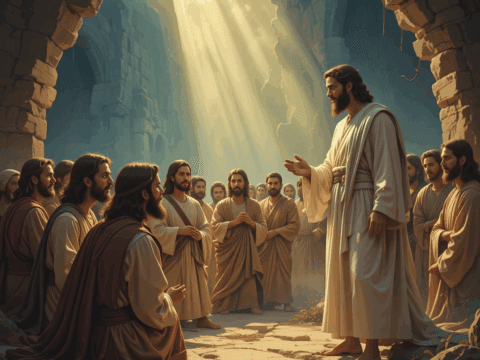
26 A week later his disciples were in the house again, and Thomas was with them. Though the doors were locked, Jesus came and stood among them and said, “Peace be with you!” 27 Then he said to Thomas, “Put your finger here; see my hands. Reach out your hand and put it into my side. Stop doubting and believe.”
28 Thomas said to him, “My Lord and my God!”
29 Then Jesus told him, “Because you have seen me, you have believed; blessed are those who have not seen and yet have believed.”
Bible Study:
Sermon Title: “From Empty Tomb to Unshakable Faith“
I. The Shock of the Empty Tomb: When Expectations are Shattered (John 20:1-10)
This first section plunges us into the raw emotions of that early Sunday morning. Mary Magdalene, along with Peter and John, face the profound mystery of the empty tomb. Their initial reaction is confusion and even despair, as they fear Jesus’ body has been stolen. But John’s declaration, “He saw and believed,” hints at the dawning realization that something far greater than a theft has occurred. This reminds us that sometimes, God shatters our expectations not to disappoint us, but to reveal a much grander plan, inviting us to look beyond our immediate understanding to a deeper truth.
II. The Personal Encounter: When Jesus Calls Your Name (John 20:11-18)
Here, we see Mary Magdalene, heartbroken and weeping, as she becomes the first person to encounter the resurrected Christ. Her initial inability to recognize Him, mistaking Him for the gardener, speaks to our own spiritual blindness at times. But then, a single word, “Mary,” spoken by Jesus, pierces through her grief and confusion, revealing His identity and transforming her sorrow into pure joy. This powerful moment teaches us that Jesus desires a personal, intimate relationship with each of us, and when He calls our name, it’s an invitation to a new mission – to share the good news!
III. The Community’s Commission: Peace, Purpose, and Power (John 20:19-23)
In this part of the story, Jesus appears to His disciples who are huddled behind locked doors, consumed by fear. His first words, “Peace be with you,” address their deepest need, reminding them – and us – that the presence of the risen Christ brings profound peace that calms all anxiety. He then commissions them, just as the Father sent Him, and breathes on them, bestowing the Holy Spirit. This demonstrates that following Jesus isn’t just a private journey; it’s a call to join a community, empowered by the Spirit, to live out His purpose and share His message of forgiveness with the world.
IV. Conquering Doubt: From Seeing to Believing (John 20:24-29)
Finally, we meet Thomas, often called “Doubting Thomas,” who missed the first appearance and declared he wouldn’t believe without concrete proof. A week later, Jesus graciously appears again, specifically inviting Thomas to touch His wounds. This beautiful interaction shows Jesus’ compassion for our doubts and His willingness to meet us where we are. Thomas’s confession, “My Lord and my God!” is a powerful declaration of faith. Jesus then gives us a profound blessing: “Blessed are those who have not seen and yet have believed.” This encourages us to cultivate a faith that trusts even when we don’t have all the answers, knowing that God’s truth is bigger than our immediate sight.
The Sermon:
Well, hey there, friends! It is so good to connect with you today. My heart is just bursting with excitement as we open up God’s Word together. You know, there’s nothing quite like gathering as a family, as a community, to explore the incredible truths that can transform our lives. And that’s exactly what we’re going to do.
You asked if I understand, and absolutely! I’m here to walk alongside you, with warmth and encouragement, just like we’re having a good, honest chat over a cup of coffee. We’re going to dive deep into what it truly means to follow Jesus – to grow, to learn, to live out this amazing journey of Christian discipleship and spiritual growth. No big, fancy words, just plain truth that speaks right to your heart and helps you take that next step with God.
So, let’s jump right into Section 9 and get into the meat of God’s Word!
The Sermon: From Empty Tomb to Unshakable Faith!
Today, we’re opening our Bibles to a powerful and pivotal moment in history, a story that changes everything for us as believers: John 20, verses 1 through 29. It’s the story of the Resurrection and the initial encounters with our Risen Savior. This passage isn’t just ancient history; it’s a blueprint for our own spiritual journey, a guide for how we grow in Christ and live as His disciples in today’s world. Let’s dig in!
The Journey to Belief: From Confusion to Conviction
This first part of our story, John 20:1-10, opens with Mary Magdalene, early in the morning, finding the tomb empty. Her immediate reaction is confusion and distress. She runs to tell Peter and John, who then race to the tomb themselves. They see the empty tomb, the grave clothes, but the full understanding of what has happened is still dawning on them. It’s a powerful picture of our own spiritual journey – often beginning with questions, with seeking, and with glimpses of truth before full clarity hits us.
My personal thoughts on this opening scene are always drawn to the raw emotion. Imagine Mary’s desperation, the hurried steps of Peter and John, the mixture of fear and wonder. It reminds me that God meets us exactly where we are, even in our confusion and our doubt. Their initial observations, while not leading to immediate full understanding, were crucial first steps. It wasn’t about having all the answers at once, but about taking that courageous step to investigate, to see for themselves. This initial movement, this running towards the empty tomb, is often how our spiritual journey begins – a whisper, a question, a need for something more.
My personal commentary here emphasizes that God often uses our searching, our curiosity, and even our initial confusion as catalysts for growth. Just as Mary, Peter, and John were drawn to the empty tomb, we are often drawn to Christ by an inner prompting, a desire for answers, or a sense that there’s more to life. Their physical journey to the tomb mirrors our spiritual journey towards truth. It wasn’t an instant revelation for them; it was a process of discovery, starting with a powerful, undeniable sign – an empty tomb. This sets the stage for a deeper, personal encounter.
In terms of Christian Discipleship, this section highlights the initial call to seek and investigate. Discipleship isn’t about being handed all the answers; it’s about actively pursuing truth, even when it’s unsettling or confusing. Mary’s immediate response was to go tell others, even if she didn’t fully grasp it herself. Peter and John’s sprint to the tomb shows an eagerness, a drive to witness. True discipleship often starts with this active pursuit, this willingness to go and see what God is doing, even if it disrupts our preconceived notions. It’s about being present and open to revelation.
For spiritual growth, this segment teaches us the value of curiosity and a willingness to step into the unknown. Mary’s initial distress quickly turns into active searching. Peter and John don’t just sit and wait; they run. Spiritual growth isn’t passive. It demands that we engage, that we look, that we ponder, even when the picture isn’t complete. It’s in these moments of stepping out in faith, even with incomplete understanding, that God often prepares our hearts for the deeper revelations to come. It’s about letting God use our honest questions to draw us closer to Him.
Sometimes, we have to see to believe, but often, we have to believe to truly see what God is doing. The journey of faith often begins with seeking physical evidence, but it matures when our eyes of faith perceive the spiritual truth.
Ask Yourself This Question: What “empty tomb” in your life is God inviting you to explore, even if you don’t fully understand what you’ll find there?
The Personal Encounter: From Weeping to Witness
Now we move to John 20:11-18, where Mary Magdalene, left weeping outside the tomb, has a truly remarkable encounter. She sees two angels, and then Jesus Himself, though she doesn’t recognize Him at first. It’s a deeply personal moment where Jesus speaks her name, “Mary,” and her eyes are opened. Her sorrow turns into overwhelming joy, and she is given a powerful commission: “Go instead to my brothers and tell them, ‘I am ascending to my Father and your Father, to my God and your God.'” This is the moment of personal recognition and transformation.
My personal thoughts here always gravitate to the tenderness of Jesus calling Mary by name. It’s not a generic address; it’s intimate, personal. It reminds me that Jesus knows us, truly knows us, in our deepest pain and our greatest joys. Mary’s transformation from desperate weeping to joyful witness is so profound. It’s not just that she saw Him, but that He revealed Himself to her in such a personal way that she couldn’t help but share the news. This is the heart of faith – a personal encounter with the living God that compels us to share.
My personal commentary highlights that spiritual growth often pivots on these deeply personal encounters with Jesus. Just like Mary, there are moments when our hearts are heavy, and we might feel alone, even when angels are near. But when Jesus reveals Himself, when He speaks directly to our hearts, everything changes. It moves from intellectual understanding to a profound, heart-level recognition. This encounter empowers us, turning our sorrow into strength and our confusion into conviction.
Regarding Christian Discipleship, this section illustrates the transformative power of a personal relationship with Christ and the immediate call to mission. Discipleship isn’t just about following rules; it’s about knowing and being known by the Living God. Mary’s encounter directly leads to her being the first evangelist of the Resurrection. This is a powerful lesson: once we’ve truly met Jesus, we are compelled to share that life-changing news with others. Our personal experience fuels our mission, turning us from mourners into messengers.
For spiritual growth, this part of the story underscores that true growth often blossoms from intimacy with God. It’s in the quiet, personal moments, when Jesus speaks to our hearts, that our faith deepens most profoundly. Mary’s recognition of Jesus wasn’t just visual; it was spiritual. This kind of spiritual sight allows us to move beyond our immediate circumstances and see God’s larger plan. It’s about letting His presence heal our hurts and empower us for His purposes, realizing that our grief can be transformed into glorious purpose.
She wept for a lost Lord, and that lost Lord found her weeping and transformed her tears into triumphant testimony.
Ask Yourself This Question: In what ways is Jesus personally calling your name today, inviting you to move from your sorrow into His purpose?
The Community of Faith: From Fear to Peace and Commission
Moving on to John 20:19-23, we see Jesus appearing to His disciples gathered behind locked doors, consumed by fear. He greets them with “Peace be with you!” and shows them His hands and side. Their fear turns to joy! Then, He breathes on them, saying, “Receive the Holy Spirit. If you forgive anyone’s sins, their sins are forgiven; if you do not forgive them, they are not forgiven.” This is about the gathering of believers, the gift of peace, the empowerment of the Spirit, and the commission to continue His work.
My personal thoughts on this scene always fixate on that powerful word: “Peace.” In their fear, in their uncertainty, Jesus offers them exactly what they need. And then, He doesn’t just show them His scars; He shares His Spirit and His mission. This is crucial for us today. We are meant to live not in fear, but in His peace, empowered by His Spirit, and actively involved in the work of His Kingdom. It’s a reminder that faith is often lived out in community, supporting each other and sharing the incredible gift of God’s peace.
My personal commentary emphasizes that a vibrant Christian life is lived out in community. These disciples were together, hiding, yes, but together. Jesus came to them, as a group. He didn’t just give them peace; He gave them purpose, together. The breathing of the Holy Spirit wasn’t just for individual solace, but for corporate strength and mission. This shows us that God intends for us to experience His peace and power not in isolation, but within the supportive, challenging, and loving context of His family, the church.
When it comes to Christian Discipleship, this section beautifully illustrates the importance of Christian community, the experience of God’s peace, and the commission to carry on His work. Discipleship is not a solo sport; it’s a team effort. We find strength, encouragement, and accountability within the body of Christ. Jesus’ commission to them, to forgive sins and proclaim His message, is our commission too. It’s about receiving His peace, letting it calm our fears, and then stepping out to share that peace and forgiveness with a hurting world, empowered by His Spirit.
For spiritual growth, this part reveals that growth often happens best in the context of community and is fueled by the Holy Spirit. Our spiritual muscles are strengthened when we gather, share our fears, and receive God’s peace together. The breathing of the Holy Spirit symbolizes the divine empowerment essential for living a fruitful Christian life. This encounter moves us from merely believing in Jesus to being empowered by Jesus to do His work. It’s about letting God replace our fear with His peace, so we can boldly step into the calling He has for us.
Their fear kept them behind locked doors, but His peace unlocked their fear and opened them up to a divine commission.
Ask Yourself This Question: How are you actively embracing the peace of Christ and the power of the Holy Spirit within your Christian community to live out your commission?
The Journey of Faith: From Doubt to Profound Belief
Finally, we arrive at John 20:24-29, the story of Thomas, often called “Doubting Thomas.” He wasn’t with the disciples when Jesus first appeared, and he declared he wouldn’t believe unless he saw and touched Jesus’ wounds himself. A week later, Jesus appears again, specifically addressing Thomas’s doubt. He invites Thomas to touch His wounds, and Thomas responds with that incredible declaration, “My Lord and my God!” Jesus then blesses those who believe without seeing. This is a powerful testament to the journey from skepticism to profound faith.
My personal thoughts on Thomas are always filled with understanding and empathy. So many of us have our own “Thomas moments,” don’t we? Moments where we need tangible proof, where our questions feel bigger than our faith. But Jesus, in His incredible grace, meets Thomas right where he is. He doesn’t condemn his doubt; He addresses it. And in doing so, He strengthens Thomas’s faith and gives a timeless promise to all of us who believe without the physical sight. It reminds me that God is patient with our questioning hearts.
My personal commentary here emphasizes that doubt is not the opposite of faith; it’s often a part of the journey to deeper faith. Thomas’s story is a profound encouragement that God can handle our skepticism. Jesus didn’t scold him; He lovingly offered the very proof Thomas demanded. This leads to one of the most powerful confessions in all of Scripture. This shows us that honest grappling with truth, even doubt, when brought to Jesus, can lead to a faith that is not just intellectual, but deeply rooted and personal.
For Christian Discipleship, this section highlights the importance of personal conviction and the call to a faith that extends beyond physical sight. Discipleship requires us to move past a secondhand faith to a personal “My Lord and my God.” Thomas’s journey reminds us that while we may seek proof, the ultimate blessing comes to those who, like us today, embrace faith in the unseen Christ. It’s about owning our belief, making it personal, and not letting our questions hinder our ultimate surrender to Him.
Regarding spiritual growth, Thomas’s story teaches us that true spiritual growth often means moving from a need for empirical evidence to a faith that trusts God beyond what we can physically perceive. We are blessed because we choose to believe, not because we have seen with our own eyes. This is the mature stage of faith – a profound, resilient trust in a Risen Savior we haven’t physically touched, but whose Spirit we experience daily. It’s about letting go of our need for absolute proof and instead embracing the incredible truth of Jesus through faith.
He needed to see to believe, but was called to believe without seeing, finding a deeper blessing in that unseen faith.
Ask Yourself This Question: What areas of your life is God calling you to trust Him in, even when you can’t physically see the outcome or have all the answers?
Section 10. Final Thoughts & Closing Prayer
Final Thoughts on John 20:1-29
Wow, what a journey we’ve taken through John 20! This passage is more than just a historical account; it’s a living, breathing testament to the power of the Resurrection and the very blueprint for our Christian lives. From Mary’s initial confusion and longing, to Peter and John’s eager pursuit, to Mary’s profound personal encounter with the Risen Lord, to the disciples receiving peace and purpose, and finally to Thomas’s journey from skepticism to a glorious declaration of faith – every part speaks to our own spiritual walk. It reminds us that our faith begins with a seeking heart, blossoms in personal encounter, is nurtured in community, and matures into a profound, unwavering trust in a Savior we may not see with our physical eyes, but whose presence we deeply feel. This chapter is an invitation to embrace the risen life, to let go of our fears, to receive His peace, and to boldly declare, like Thomas, “My Lord and my God!” It is a powerful affirmation that our God is alive, active, and deeply personal.
Closing Prayer
Let’s bow our heads and close our hearts in prayer.
Heavenly Father, we come before You today with hearts full of gratitude for Your incredible love and the life-changing truth of Your Risen Son, Jesus. Thank You for the story of John 20, for showing us that You meet us in our confusion, calm us in our fears, and transform us in Your presence. We pray, Lord, that You would deepen our faith, just like You did for Mary and Thomas. Help us to be eager seekers of Your truth, empowered by Your Spirit to share Your peace and purpose with a world that so desperately needs You. May we walk in true Christian discipleship, growing daily in our understanding and obedience, and may our spiritual growth be evident in every area of our lives. Fill us with Your peace, strengthen us in Your community, and enable us to declare, with every fiber of our being, that You are our Lord and our God. We pray all this in the mighty and matchless name of Jesus, our Risen Savior. Amen.
Section 11. Closing Hymn or Worship Song
Alright, church family, before we head out, let’s stand together as a community, united in worship. There’s something so powerful about raising our voices together, isn’t there? Let’s close our time by singing a song that declares the incredible truth of our Risen Lord and the joy of walking with Him. Let this music be a celebration in your heart, a promise for your week, and a declaration to the world.
Section 12. Benediction
Now, as you go out into your week, may the Lord bless you and keep you; may the Lord make His face shine upon you and be gracious to you; may the Lord lift up His countenance upon you and give you peace. Go in the peace and power of our Risen Lord, to live out the discipleship He has called you to, and to grow in the grace and knowledge of our Savior. Amen.