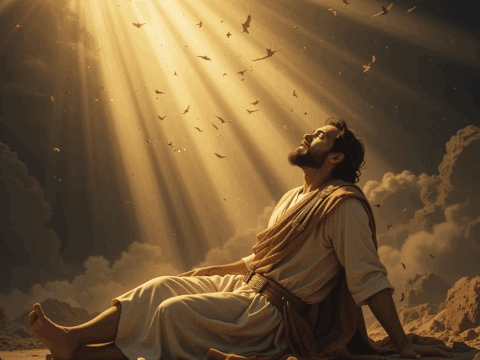
Recognizing God is present before you turn the sanctuary into a storage unit.
Genesis 28:10-19 – Bethel: Finding a Foundation in the Desert
Don’t Start With A Blank Page?
Inviting them to use our Bible Study and tools to build their ministries, we welcome every preacher who has ever looked at a blank page and felt like Jacob in the wilderness—resting their head on a stone in a lonely place. Sermon preparation doesn’t have to start in a vacuum; just as God provided Jacob with a vision of a ladder reaching to heaven, our resources provide the bridge between the ancient text and your modern congregation. We offer the structure and insights you need to turn that empty screen into a “Bethel,” a place where the presence of God is clearly revealed through your teaching.
- The Significance of Jacob’s Ladder and Divine Presence
- Building a Sermon Framework from the Ground Up
- Turning Desolate Preparation into a Sacred Encounter
Ready to continue?
Bible Study: Encountering the Presence in the Ordinary
Introduction to Genesis 28:10-19
The passage of Genesis 28:10-19 marks a pivotal transition in the life of the patriarch Jacob. Having fled the wrath of his brother Esau after a series of family deceptions, Jacob finds himself in the vulnerable position of a fugitive.
This text introduces us to a man caught between his past mistakes and an uncertain future. It is in this “in-between” space a place of exhaustion and isolation that God chooses to initiate a profound encounter, transforming a lonely campsite into a sacred portal.
The Events of the Passage
As Jacob travels from Beersheba toward Haran, the sun sets, forcing him to stop in an unnamed location. Using a stone for a pillow, he falls into a deep sleep and receives a vivid vision: a stairway reaching from earth to heaven with angels ascending and descending. Above it stands the Lord, who reaffirms the Abrahamic covenant, promising Jacob land, numerous descendants, and divine protection.
Upon waking, Jacob is struck by a holy fear, realizing that God was present in a place he had deemed ordinary. He consecrates the stone pillow as a pillar, pours oil on it, and renames the site Bethel, meaning “House of God.”
Genesis 28:10-19 (NIV)
10 Jacob left Beersheba and set out for Harran. 11 When he reached a certain place, he stopped for the night because the sun had set. Taking one of the stones there, he put it under his head and lay down to sleep.
12 He had a dream in which he saw a stairway resting on the earth, with its top reaching to heaven, and the angels of God were ascending and descending on it. 13 There above it stood the Lord, and he said: “I am the Lord, the God of your father Abraham and the God of Isaac. I will give you and your descendants the land on which you are lying. 14 Your descendants will be like the dust of the earth, and you will spread out to the west and to the east, to the north and to the south. All peoples on earth will be blessed through you and your offspring. 15 I am with you and will watch over you wherever you go, and I will bring you back to this land. I will not leave you until I have done what I have promised you.”
16 When Jacob awoke from his sleep, he thought, “Surely the Lord is in this place, and I was not aware of it.” 17 He was afraid and said, “How awesome is this place! This is none other than the house of God; this is the gate of heaven.”
18 Early the next morning Jacob took the stone he had placed under his head and set it up as a pillar and poured oil on top of it. 19 He called that place Bethel, though the city used to be called Luz.
Bible Study: The Leader’s Encounter at the Gate of Heaven
Friends and fellow laborers in the vineyard, we often find ourselves in what the scriptures call “a certain place.” For many of you whether you are balancing a secular career with a pulpit supply role, or you are a weary board member navigating the complexities of church governance this “certain place” often feels like a place of exhaustion.
We are tempted to think that God only moves in the grand cathedrals or the perfectly executed worship sets. However, the story of Jacob at Bethel teaches us that our most profound moments of spiritual growth often happen when we have nothing but a rock for a pillow and a heart full of uncertainty. The Lord does not wait for us to reach our destination to speak; He meets us in the wilderness of our transition.
Expository Sermon Outline: Waking Up to the Presence
1. The Reality of the Hard Place (Verses 10-11)
2. The Revelation of Divine Connection (Verses 12-15)
3. The Awakening of Spiritual Awareness (Verses 16-17)
4. The Consecration of the Common (Verses 18-19)
For the Weary Bi-Vocational Leader
You are often living in the tension of two worlds the “Beersheba” of your secular employment and the “Haran” of your ministry calling. Like Jacob, you may feel you are sleeping on a metaphorical rock, exhausted by the dual demands on your time. Remember: The stairway appeared while Jacob was resting, not while he was working. Your effectiveness in the pulpit is not fueled by your frantic activity, but by your ability to recognize that the ground of your secular workplace is just as much “the gate of heaven” as your sanctuary.
For the Worship and Music Leader
Jacob’s stone became a pillar, and his experience became a song of sorts a declaration of God’s presence. In the chaos of rehearsals, broken sound equipment, or missing vocalists, it is easy to lose sight of the “awesome” nature of the space. Your role is to help the congregation wake up from their spiritual slumber to realize that “the Lord is in this place.” We don’t manufacture the presence of God; we simply point to the stairway that is already there.
For the Church Board and Strategic Planners
It is easy to focus on “Luz” the city as it used to be, the old traditions, or the structural limitations of the budget. However, leadership requires the vision to rename the place “Bethel.” When you look at the “stones” of your church the hard challenges and the unyielding problems do not see them as obstacles. See them as the raw materials for a pillar of testimony. Your strategic planning should not just be about maintenance, but about creating an environment where people can clearly see the divine commerce between heaven and earth.
Bible Study Discussion Questions
Closing Benediction: The Leader’s Commission
The Bethel Benediction
You’ve completed the Free Bible Study!
The Sermon Preview Below is just one example of the practical, ready-to-use resources included with Pastor Essentials each week.
Start Your FREE 7-Day Trial Today
Get immediate access to:
- The Complete Bible Study and Sermon
- Two additional weekly lectionary sermon packages
- Ready-to-use Bible Studies
- Service outlines, prayers, and ministry resources
- New content added every week
Only $9/month after your free trial. Cancel anytime.
Prefer just this sermon?
Purchase this Sermon & Bible Study for $4.99
Below is a preview of this week’s paid Pastor Essentials Sermon Content, so you can see how the material is organized, presented, and prepared to support pastors, teachers, and lay speakers throughout the week.
The Sermon: Finding God in the Hard Places?
1. The Reality of the Hard Place (Verses 10-11)
Life has a way of leading us into “certain places” where the sun sets on our plans, our energy, and our confidence. In these verses, we find Jacob at his lowest point lonely, tired, and literally resting his head on a rock. This section explains that spiritual growth often begins not when we are on a mountaintop of success, but when we are in the valley of transition. It’s in these moments of forced stillness that we are finally quiet enough to hear what heaven has to say.
When I think about Jacob lying there, I’m reminded that so many of us are exhausted by trying to manage our own lives. We think that if we stop, we fail. But Jacob’s “stop” wasn’t a failure; it was an appointment. My personal thoughts often return to the idea that God uses our exhaustion to break through our self-sufficiency. We don’t choose the rock, but God chooses the rock to be the place where we finally look up.
In my personal commentary, I see that the “stones” of our lives the hard circumstances, the financial stress, the health scares are not obstacles to God’s plan; they are the furniture of His presence. We often spend our lives trying to avoid the hard places, but the text shows us that the hard place was exactly where Jacob needed to be to receive the vision. God doesn’t wait for us to find a comfortable bed to give us a breakthrough.
Regarding Christian discipleship, this passage teaches us that following Jesus isn’t about avoiding the wilderness; it’s about learning how to rest in the wilderness. A true disciple understands that God is just as present in the “sunset” moments of life as He is in the “sunrise” moments. Discipleship is the art of staying put when the sun goes down and trusting that the Lord of the Day is still the Lord of the Night.
Reflecting on spiritual growth, I’ve realized that we grow more in the dark than we do in the light. Just as seeds germinate underground, our character is often formed when we feel buried by circumstances. Growth isn’t about how fast you are running toward Haran; it’s about how deeply you can rest on the “stone” God has provided for your current season. Your spiritual maturity is measured by your peace in the “certain place.”
Remember: We must stop trying to make God fit into our plans, and instead let our plans be made by God. This means that instead of asking God to bless what we are already doing, we should pause to see what God is already doing and join Him in it.
Ask Yourself This Question? Are you trying to run away from the “stone” in your life, or are you willing to lay your head down and see what God wants to show you through it?
You’ve Just Seen a Sample of Pastor Essentials
The preview above is just one example of the practical, ready-to-use resources included with Pastor Essentials each week.
Start Your FREE 7-Day Trial Today
Get immediate access to:
- This complete sermon and Bible study
- Two additional weekly lectionary sermon packages
- Ready-to-use Bible studies
- Service outlines, prayers, and ministry resources
- New content added every week
Only $9/month after your free trial. Cancel anytime.